
|
|


Colony Jerusalem
|
|
Holy Birds
Colony of the Western Wall in Jerusalem
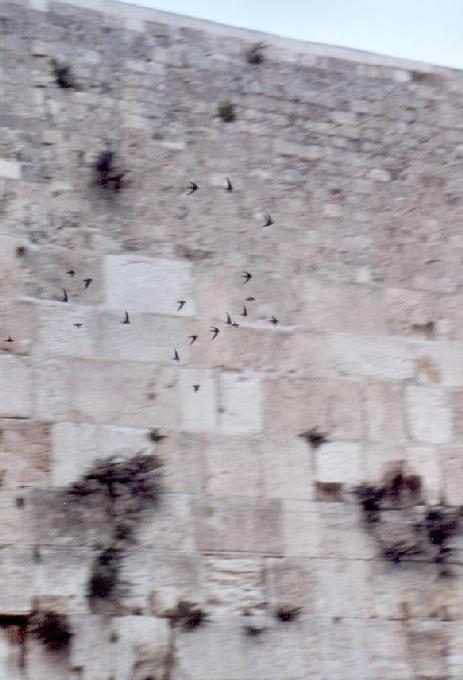
In the year 2001 Rabbi Yosef Cornfeld informed me that there were crowds of Common Swifts circling around the Western Wall in Jerusalem. They would fly so low and so fast that the praying people would duck. (See his reports in the Discussion Forum and in APUSlife). This is why I consulted Prof. Mendelssohn from Tel Aviv University and we decided to take a closer look at this colony.
In Spring 2002, I spent two weeks in the Old City of Jerusalem and had the opportunity to study the life of the colony in the Western Wall.
The nesting sites
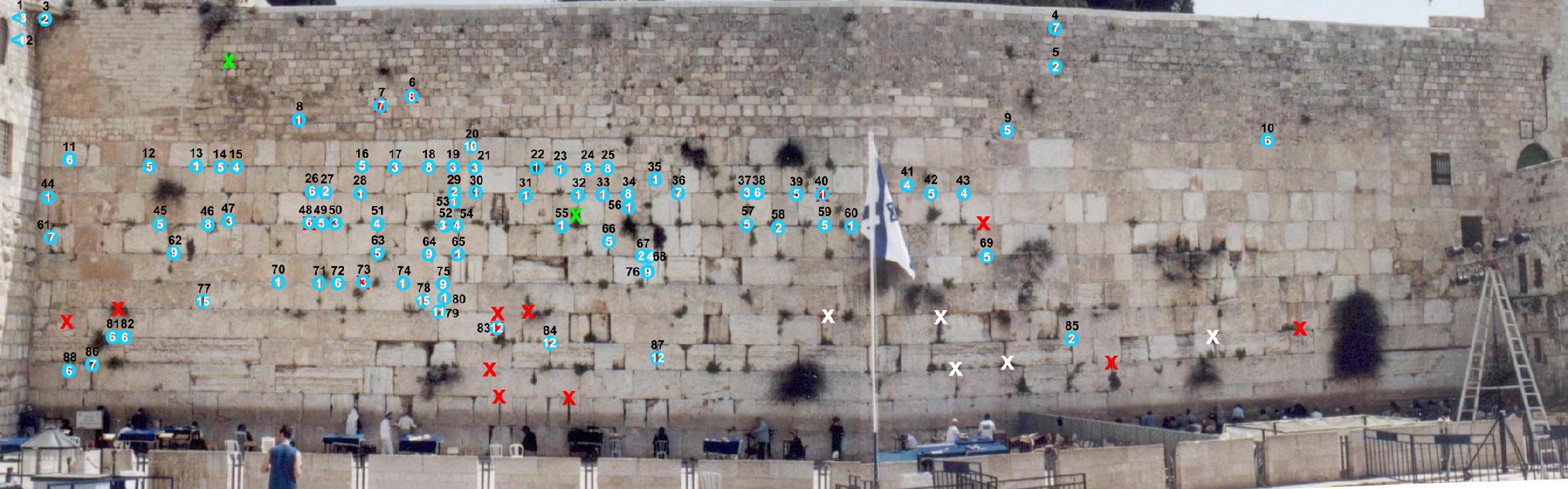
The potential nesting sites in the Western Wall in 2002 (© Ulrich Tigges). Blue circle = Common Swift (Apus apus) no. 1 and 2 are out off sight, red X = House Sparrow (Passer domesticus), green X = Jackdaw (Corvus monedula) and white X = Feral Pigeon (Columba livia forma domestica). Black number = number of holes; white number = count of flight ins. Note that some holes are shared by more than one species.
The Common Swifts entered 88 holes of the Western Wall inclusive one cavity in the stone that connects the Wall and the neighbouring synagogue (hole no. 1), and two more in the wall of the synagogue (holes no. 2 and no. 3).
Three more species of birds entered this famous Wall. I was able to register two holes of Jackdaws, five holes with feral pigeons and 15 with House Sparrows. Five holes were shared by Common Swifts and House Sparrows.
All together I counted 412 flight ins of the Common Swift.
Count of entries the holes 1-5 times into 57 holes 6-10 times into 25 holes 11-15 times into 6 holes
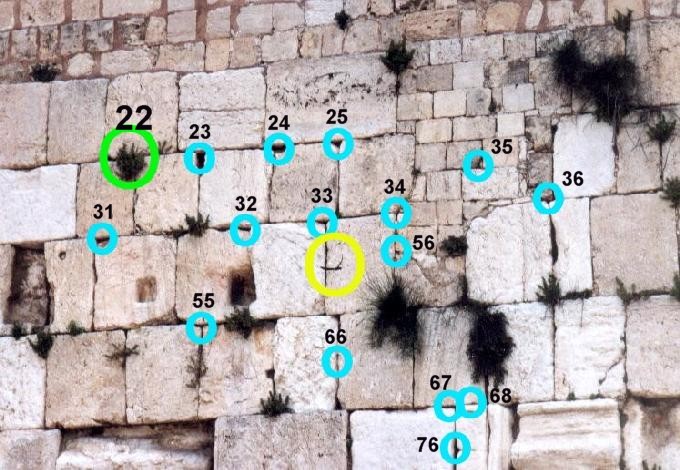
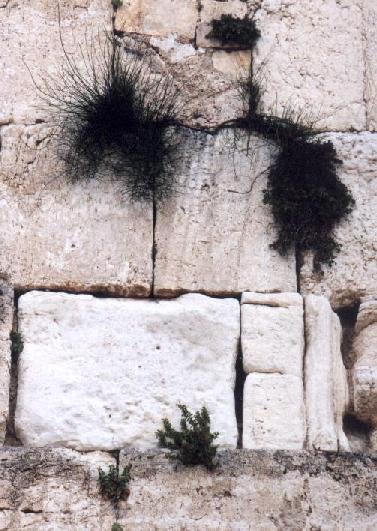
Most of the holes are situated about nine metres high between the 9th and 10th row of the stones. 16 nesting sites can be found here alone. The fewest can be found in the southern part. It seems that more cracks are filled with mortar here. In some holes (nos. 14 and 15) the Common Swifts entered obliquely, that is, the cavities are at an angle. In nesting site no. 20 the Swifts flew straight into the cavity without touching the entrance hole. In another four nest sites (nos. 41, 76, 77, 87) the Swifts make a 90° turn just before the entrance hole and flew into it in this position, without touching the entrance. One may assume that in such cases, the nesting site is at a certain distance from the entrance hole and that the approach to it is large enough to allow the bird to fly within it. Two holes are behind vegetation (nos. 22 and 63).When the plants grow further, the nesting sites cannot be reached by the Swifts anymore.
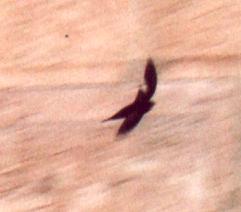
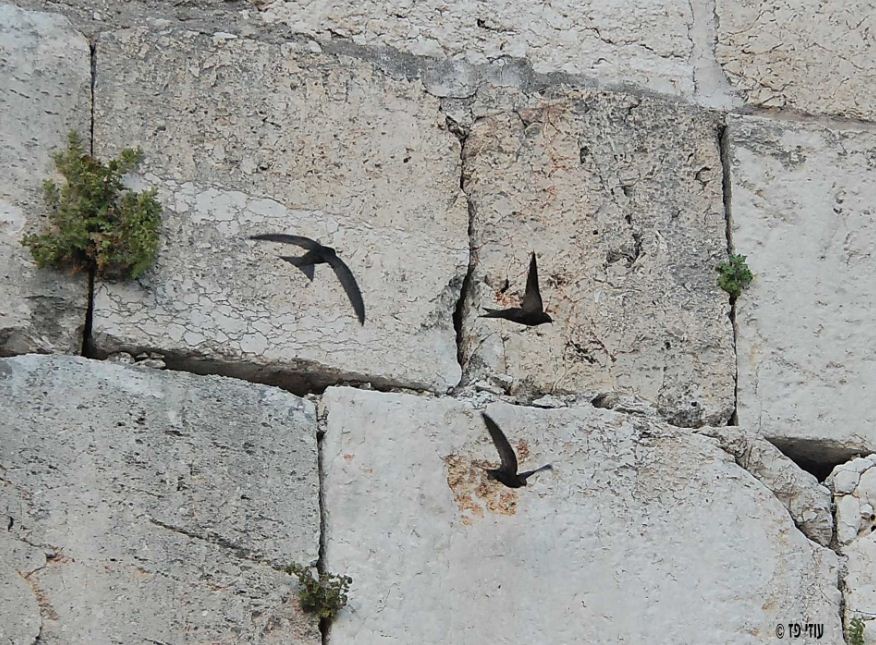
The free access of hole number 22 is endangered. The bush is going to cover it. In the middle of the picture you see a Swift sailing alongside the Wall.
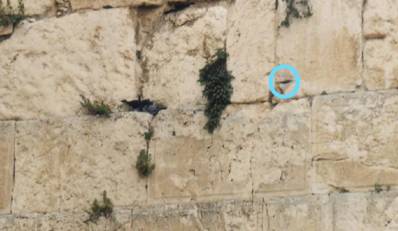
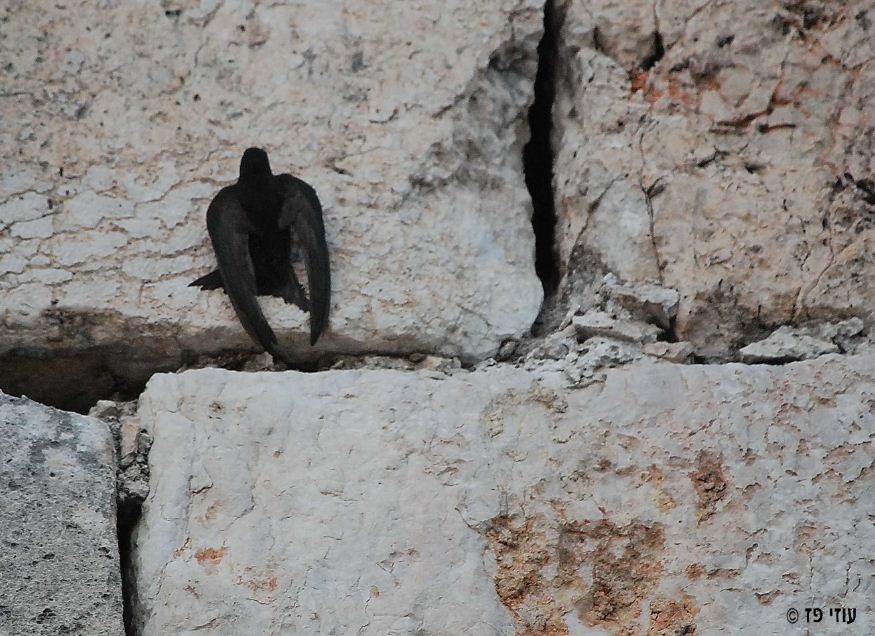
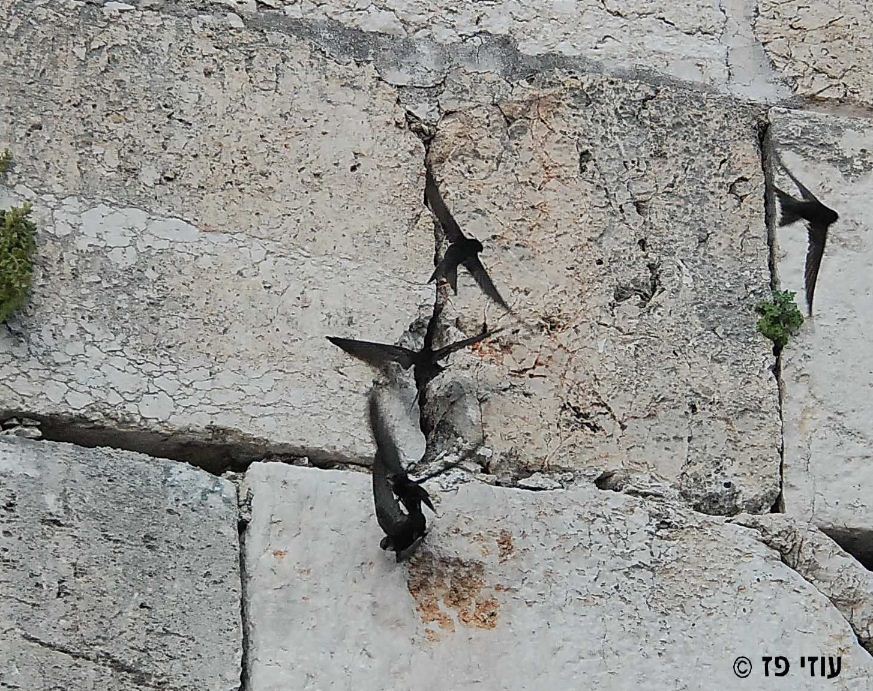
Hole no. 76. Shortly before entering the parents make a turn of 90° and then fly into the hole, one tip of the wing pointing down, and the other pointing into the sky
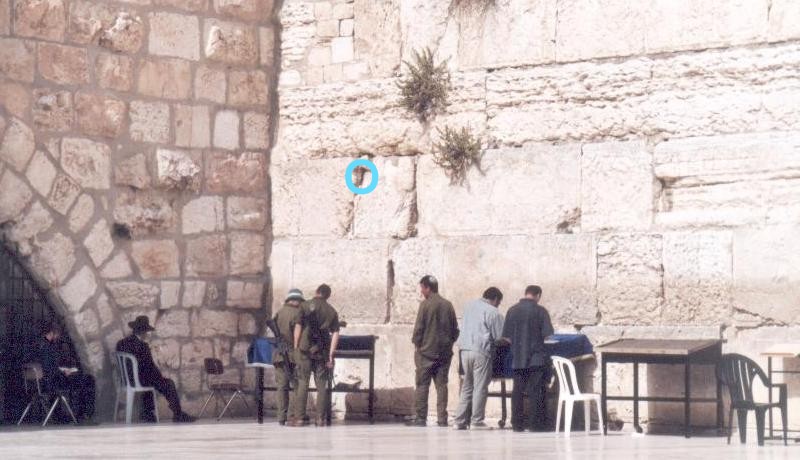
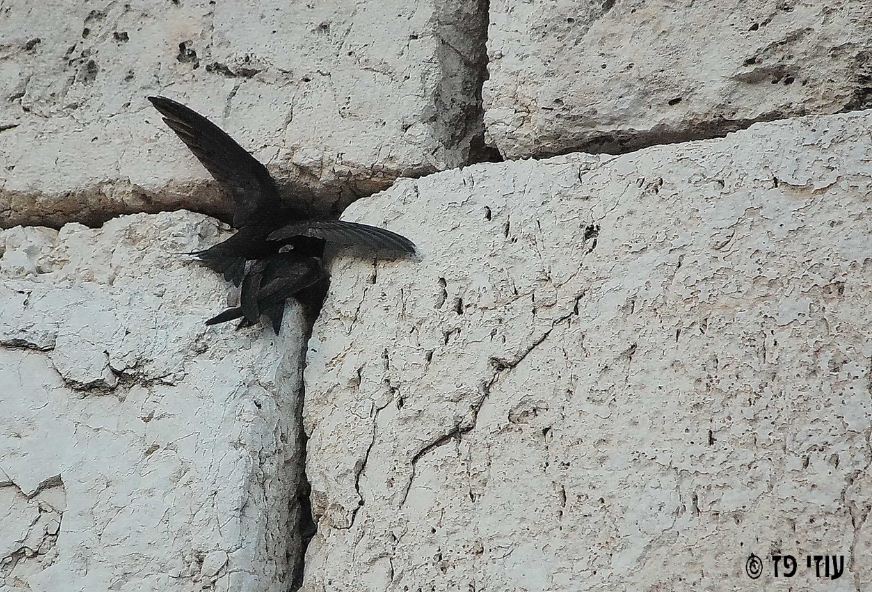
Sometimes the Pigeons disturb the Common Swifts and sit in front of their entrance holes and block the entry, as seen in hole no. 62. The Swifts then patiently fly around and try again and again to get to their nest; they do not attack the Pigeons or show any aggression.
Hole no. 62 is temporarily blocked by Pigeons. The owners have to wait (blue circle).
The lowest nesting site was in a cavity created by damage to the stonework in the third row (no. 88). The bird which occupied this nest site had two feathers missing from its left wing. Despite this anomaly, the bird was able to live normally and breed successfully since 2001 (after Rabbi Cornfeld).
This bird lacks two feathers. It was seen for 2 years entering hole number 88, where it probably rised its young.
The lowest hole in which Common Swifts breed, about 270 cm above the ground. It is the home of the individual with missing feathers in the left wing.
Some other observations
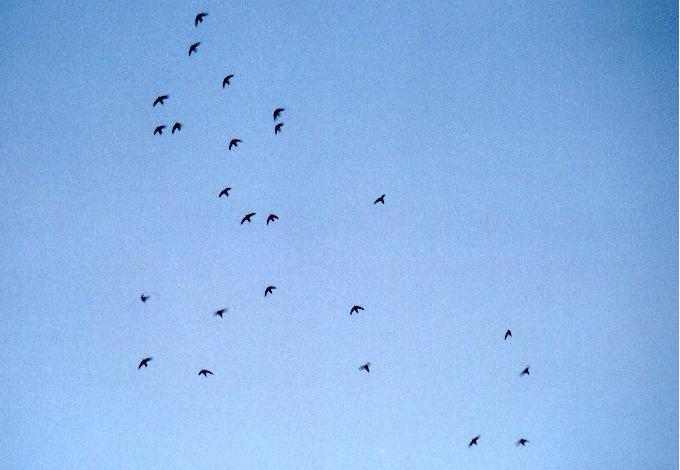
The highest density of birds was noted around sunset. These observations were the same as in Tel Aviv (APUSlist No. 2856). All non-breeders are back from their daily excursions and fly around the colony. Those who own a nesting site enter the holes for the night, while those who do not will fly to impressive height and spend the night on the wing. Mostly the non-breeders from several colonies assemble for this, and, as dusk gathers, they fly higher and higher while screaming loudly. This phenomenon could be observed twice directly above the Kotel Plaza during the study. On the 22nd at 18.54 hours in twilight the Common Swifts of the Western Wall and those of the Temple Mount assembled at high altitude. From 19:02 until 19:11 hours this group increased to about 50 individuals. On the 25th , 40 – 50 Swifts came together between 19:15 and 19:30 hours at high altitude; some of them later came down to a lower altitude, as also happened on the 22nd. The remainder of the party disappeared into the darkness. At 19:35 only their screams could be heard.
On some days, e.g. on 15th, 22nd, 23rd, 24th and 25th, there were Common Swifts at the Plaza in the early afternoon between 15 and 17 hours. In different periods 2-15 individuals could be counted. On 17th, 21st and 26th , the skies remained empty at this time except for birds in transit and feeding parents. But an example of how differently groups can behave was provided by a flock of 20 Swifts which circled above Ben Yehuda Street on 17th at 13.40 hours.
Colony area
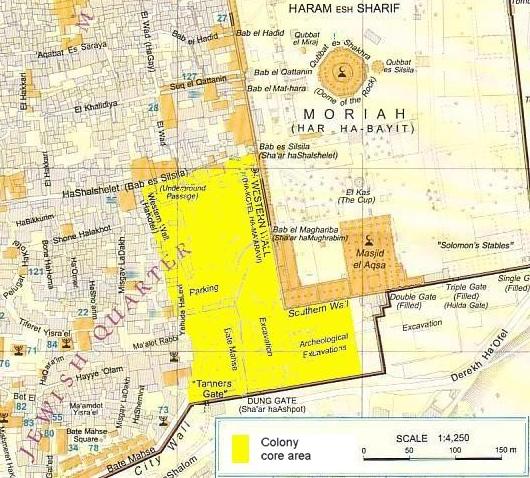
The frontier of the core of the Western Wall colony was the Western Wall itself with the Plaza in front of it, the neighbouring houses and the parking place in the south down to the City Wall and some of the ruins of the Umayyad palace.
The core area of the of the Common Swifts colony from the Western Wall. (Extract of Jerusalem Visitors’ Map 1999, Publ. by the Ministry of Tourism, changed)
It was interesting to see that those Swifts which flew to the Ruins of the Umayyad Palace never took the short cut above the Temple Mount, but always flew alongside the Western Wall, and then turned to the East.
Colony size
The Western Wall colony contained about 120 Common Swifts. About 30 pairs were breeding in the Western Wall. About 25 (20-30) individuals owned a nesting place, but were not breeding. This can be estimated from the numbers of birds in the flocks that flew into the colony most often. About another 30 (20-40) Swifts were non-breeders without a nest site. They only lived in the colony territory when the weather was suitable.
Prof. Heinrich Mendelssohn died 19.11.2002 before the paper mentioned below was completed. It seems that this joint work was the last part of his immense contribution to the ornithology of the Middle East. - The idea of the heading came from Rabbi Cornfeld.
Further information about this colony:
Ever since 25th February 2008 Amnonn Hahn and the FRIENDS OF THE SWIFTS R.A. have organised an annual Welcoming Ceremony on the Kotel Plaza with the Western ("Wailing") Wall and its Swift colony as a breath-taking background. The home of the Prophet Jeremiah, the ancient City of David lies just a few yards away. It was Jeremiah who first noted the periodical and punctual return of the Swifts (Jeremiah 8.7), thus founding an impressive series of observations of the species at this site.
Papers written about this colony:
Tigges, U. & Mendelssohn, H. (2005): Phenology and Behaviour of the Common Swift Apus apus in Israel. Holy Birds, or the Common Swifts of Jerusalem’s Western Wall. Sandgrouse 27: 82-87, APUSlist No. 2854
Tigges, U. & Cornfeld, Y. (2005): Plumage deviation in the left wing of Common Swift Apus apus. Sandgrouse 27: 162-163, APUSlist No. 2971
Some more photographs from the colony
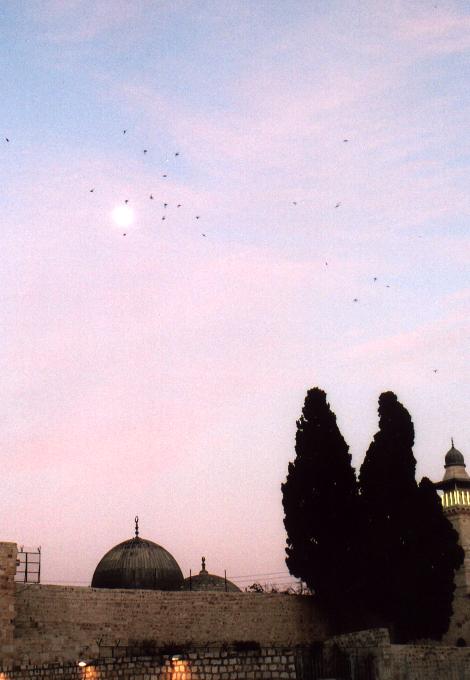
A flock above the Al Aqsa Mosque in the evening
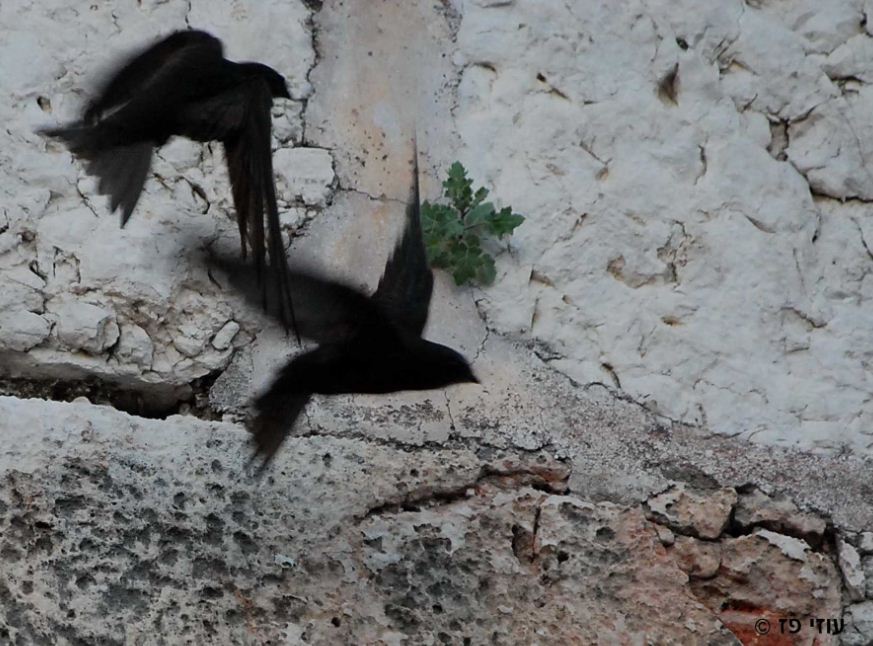
A loud-screaming flock flying in circles at high speed in front of the Western Wall
A group of Common Swifts flying above the Western Wall Plaza
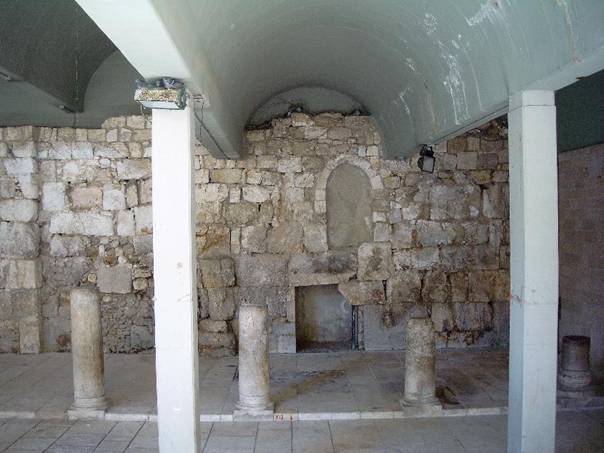
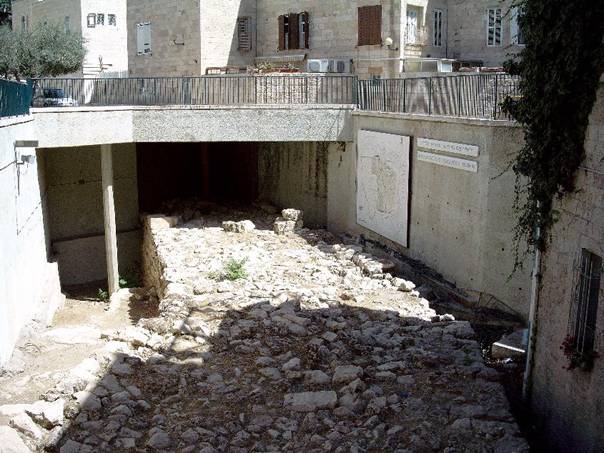
There are also some interesting things to report from a neighbouring colony. Rabbi Cornfeld observed for a couple of years that Swifts fly into the underground of the Cardo, which might indicate that there is a nest. I observed the same thing below the overhanging Bonei ha Khoma which crosses the Wide Wall.
Swifts fly here and seem to have a nest in the Cardo.
They also fly under the street which crosses the antique Broad Wall.
Swifts Welcome-Ceremony in the Western Wall
|
Commonswift Worldwide © Ulrich Tigges
پرستو, Čiurlys, Црна чиопа, Apus apus, Rorýs obecný, Commonswift, Tir ababil, Gierzwaluw, Qara uzunqanad, رقيعي، خطاف, 서양칼새, Гара узунганад, Sis hachomot, סיס החומות, Mursejler, Tårnsvale, Spyr, Randurel pitschen, Tervapääsky, Piiritaja, پشه خوار, Սև մանգաղաթևին, Mursejler, Gollan mooar, Falzia, Dážďovník obyčajný, Мала пишталка, Gobhlan mor, uHlolamvula, Kara Sağan, عام جلد, Yôroppa Ama-tsubame, Ihlabankomo, Feigdarsveimari, Drepnea neagră, кара кардыгач, طير نبابيل, Samama, Обична пишталка, Čiopa, Svīre, Tårnseiler, ნამგალა, Crna ciopa, Chyorny strizh, Ешкіемер, Rundun, Sorbeltz, 검은등칼새, Gierzwaluw, ヨーロッパアマツバメ, Sev Mangaghatev, Namgala, Қара сұрқарлығаш, Vencejo común, iJankomo, Mbayuwayu, Черный Стриж, Zapli, Martinet noir, Europese Windswael, Tornseglare, Rondone comune, Қарлық, Teleka wa Ulaya, Gwennol Ddu, Хурын ураацай, Črni hudournik, Rondone, Σταχτάρα, السمامة, Mauersegler, Gara atgarlawaç, черен бързолет, Sorbeltz arrunta, Dejka, Komuna apuso, Andorinhão-preto, Ebabil, Falciot negre, Spāris, Mönasval, Lehaqasi, Leahttospálfu, Gwennol ddu, Чорний стриж, Falföcske, Jerzyk, 北京雨燕, Sarlósfecske, Múrsvölungur, Gabhlán Gaoithe, Чорны свіргуль, Bezdelīga, Swifts
Commonswift's topography, togography of the Commonswift, feathers, crown, eye line, eye patch, forecrown, lore, chin, throat, ear coverts, hindneck, mantle, scapulars, rump, uppertail coverts, tail, tertials, greater coverts, secondaries, median coverts, leading edge coverts, lesser coverts, lesser primary coverts, alula, median primary coverts, leading edge coverts, greater primary coverts, primaries, median coverts, greater coverts, secondaries, axillaries, undertail, undertail coverts, rear flank, vent, flank, belly, brest, apodidae, apodiformes, size, color, colour, weight, sex, flight acquaintance, flight speed, age, food, enemies, pair bonding, nest, eggs, egg, young, bad weather, voice, download wave file, survive, survival, colony, flying insects, baby bird, hand rear a baby swallow, baby swallow, Jerusalem, Klagemauer, Mauersegler.