|
Permanent Flight
Perhaps the most remarkable feature of the Swift is its life of
permanent flight. Swifts only touch down to reproduce. They will
cling to a wall or rock-face to check a potential nest hole, and
they will spend the night in such a hole to establish it as
their nest site. When incubating their eggs and feeding their
young they stay in the nest hole and bring food there for the
chicks, but otherwise, all their life is spent on the wing.
Swifts stay aloft night and day, Summer and Winter alike. A
Swift can spend its first two or three years on the wing before
breeding, and making its first ever landing.
Such an ability is unique. No other bird can even approach it.
Only Frigatebirds (Fregata sp.) are known to be capable
of spending months in flight over the seas, taking their food
whilst on the wing.
Lifespan
The age record for a Swift is 21 years. This was a bird ringed
as a chick at its nest in Switzerland, and recorded again there
21 years later. By then it had flown perhaps 4.8 million
kilometres (3 million miles).
Unique adaptations
The Swift has evolved into such a perfect airborne creature,
that its feet and legs have retained few of the abilities of
those of other birds. The minute, slightly curved feet are ideal
for clinging to walls and rock-faces, but useless for holding on
to a perch, or for walking or even hopping along the ground.
Speed
Swifts look fast, and they are. Their aerobatic territorial and
social display flight can take them to a speed of 220 km (137
miles) per hour, a record for birds of this size. Only the
Alpine Swift (Apus melba) and the Peregrine Falcon (Falco
peregrinus) can match this, and they are considerably
bigger, heavier birds with substantial body-mass.
Range
Their fast and continuous flight, combined with the drift effect
of the wind, has produced sightings of Swifts at great distances
from their breeding areas.
Illustrating this are observations of Swifts made well inside
the Arctic Circle, over Spitsbergen, and in the area between
Novaya Zemlya and Franz Joseph Land, more than 1000 kilometres
North of any likely breeding site.
During the permanent daylight of the far North, the "White
Nights", Swifts fly and feed continuously, and only stop their
screaming calls for about 2 hours.
Winter Sightings
In general, Swifts arrive in their breeding territory a few days
before they start to nest, and leave it a couple of days after
the young have flown.
They arrive in Israel in the first week of March, and leave in
the first week of June. In London they are usually present from
the first week in May until the first week in August. Further
North, in Lapland, they are present from the first week of June
until the first week of September.
But there are always some birds that arrive and leave either
earlier or later than the mass, sometimes at such extreme dates
that we do not know whether they are too early or too late.
Hence the description “unusual presence”.
A
Swift was observed at Billingen in Sweden on 31st October 1918.
In the period up to October 1941 Swifts were observed above
frozen lakes on the Finnish-Soviet border, and at Frankfurt in
Germany on 4th November 1965. Swifts were seen in South Wales in
the United Kingdom (UK) several times between 2nd October and
17th November 1882, and several were seen in the period up to
12th November 1957 in Malmö and Lund in Sweden.
Even more unusual reports concern a Swift sighted at Marseilles
in France on 12th December 1909, and another seen from 3rd to
8th February 1967 in Essex in the UK.
While some of the above sightings took place in relatively
temperate climates, Swifts, who rely exclusively on a rich
supply of airborne insects for their food, have nonetheless been
observed above ice and snow-covered landscapes. One such record
is of Swifts seen at Pomosdino, Upper Vitchegda in Russia, on
30th September 1930, when there was 25 cm (10 inches) of snow on
the ground.
There have also been reports of Swifts assumed to be sleeping.
One was found in a belfry in Dover in the UK in the Winter of
1831, and another was disturbed and flew away during works on an
attic on the 18th December 1990. Some evidence that this was
indeed a Swift, and not a bat, was provided by the corpse of a
second bird present in the attic.
Unusual locations and nesting places
Swifts live either in the skies, or else in their nest holes.
Non-breeders will check nest sites, flying repeatedly to
existing or potential sites. Sometimes they scream at the
entrance to test if the sites are occupied or not. They may then
enter the holes to make a further assessment. But otherwise they
stay aloft.
Sometimes, however, they have been found in unusual places. In
Sweden, juvenile Swifts have been observed clinging to trees
overnight, hanging by their feet, their backs parallel to the
ground.
At the Courland Lagoon in Lithuania, Swifts were found clinging
to a balloon. Swifts have also been seen clinging to building
gutters and bargeboards.
Swifts have been found in bad weather in a cave only one metre
above ground level. Six Swifts were also found in a starling's (Sturnus
vulgaris) nest may be sheltering, and after three days of
continuous rain one pair were found dead, sitting on two chicks
in their nest sited on a wall of a church.
Swifts have been reported breeding in a House Martin's (Delichon
urbica) nest, in a stack of drying peat blocks, and also in
a nest in full sunlight. Low nest sites of about three metres
(10 feet) above ground level are quite common, but perhaps the
lowest typical nest site reported was at about a metre (3.3
feet) high, in a stone wall banking the River Rhine in Germany.
However, there is also a report of a brood being found in an
"earth hole", in Romania, and even more bizarre, there is a
report of a Swift seen copulating repeatedly for ten minutes on
top of a wall.
In Catalonia, Swifts have been observed taking off after a short
run across a roof, and there has been a record of a Swift
actually pushing slates from a roof!
Low light level ability
It is clear that Swifts have quite exceptional eyesight, but
their activity in the depths of night is usually restricted to
high level "sleeping" flight. However, there is a record of a
Swift arriving on its nest 90 minutes after dusk, when it was
completely dark, and I have observed a Swift checking a nest
site at a light level of only 1 lux, in almost complete
darkness.
Accidents
We tend to assume that such skilled and perfect flyers as Swifts
will have a low or a nil accident rate. This is pretty much the
case, such accidents as have been observed being sufficiently
unusual to warrant comment and recording.
In 1832 a Swift was observed flying straight into a wall, and
falling away dying. It was found to be carrying many parasites,
and it was thought that it had committed suicide, but this
anthropomorphic assumption is almost certainly wide of the mark.
There is also a report of a Swift flying straight into the sea
when pursued by an Arctic Skua (Stercorarius parasiticus),
and another of a Swift, somehow caught by a Crow (Corvus
corone sp.), flapping and screaming until the Crow released
it.
In 1930 a fatal collision between two Swifts was noted; they had
each flown along opposite sides of a wall, and turned into each
other at the end.
In Holland a Swift was killed by a tennis ball, and in
Thuringia, Germany, fire fighters released a trapped Swift from
a hole in a wall. We also have a very curious report of a Swift
being killed by a tree in the Congo.
But there is little if any information on Swift mortality and
disease. I have been able to find only one, scarcely
satisfactory, report which concludes that a young Swift died of
indigestion.
Multiple Broods
Swifts raise one brood each year, and this takes them between 70
and 80 days, depending on the weather. The food supply for the
chicks is absolutely dependent on the weather; if it is cold or
wet airborne insects are unavailable.
Under these conditions and within the restrictions of a 100-days
stay, multiple broods are not feasible, and most of the reports
of multiple broods refer to multiple clutches, i.e. egg laying
only.
This is a fairly common occurrence, and there are two known
reasons. The first is that during prolonged periods of bad
weather and food shortage the parents may throw the eggs off the
nest, and try again later when food supplies are better.
The second is that fights between the birds can cause damage to
the eggs or knock them out of the nest. These fights occur when
other Swifts intrude, seeking to take over an occupied nest
site. They can be severe, and can last for several hours, the
birds remaining locked together in their struggle.
In both cases, the adult birds will produce a second clutch.
There have been several reports of up to three replacement
clutches being laid in this way, in one of these the chicks
fledging three weeks after the parents left the nest.
True double broods are extremely rare; there are only two known
records from Gütersloh in Germany and Copenhagen in Danmark.
Misinterpretation and Misinformation
With a bird as difficult to observe as the Swift, mistakes and
tall stories are bound to proliferate. For instance, there was a
report from England that Swift chicks with an age differential
of 4 weeks had been found in the same nest. Also coming from
England was a series of reports, purporting to have scientific
backing, of young Swifts returning repeatedly to their nests.
The general consensus is that such a return is impossible; once
fledged the young birds leave their nest, and do not return to
it before they migrate.
However returns to the nest to breed have been reported in
larger colonies, such as Kronberg in Germany, and Tel Aviv in
Israel. Swifts usually return to the area where they were born
to breed, and from ringing recoveries it has been established
that in two cases, chicks from a specific nest returned there as
adults to breed some years later.
A
Swiss observer reported seeing 56 Swifts entering the same hole.
This too is unprecedented, and one has to suppose they were in
fact bats entering the hole to get to their own roost. There are
recent reported cases of two Swift pairs sharing a single entry
hole to two quite separate nest sites (in Tel Aviv, Israel) but
otherwise the birds are so aggressive, that sharing a nest space
and entry hole is extremely unlikely.
Likewise reports of mutual feeding by pairs of Swifts on the
wing in spring are likely to be caused by a confusion between
species, or activity.
Reports of Swifts scraping insects off walls with their wings to
catch them, and banging gutters to dislodge insects are simply
mistaken; Swifts behave like this when clinging to walls and
inspecting potential nest sites; they are not feeding.
Likewise, a Swift reported as brooding three Starling (Sturnus
vulgaris) chicks, was without doubt trying to regain a
usurped nest space. Its intentions were not maternal.
Every now and then there is a report of Swifts taking a short
cut through the Great St. Bernard Pass Tunnel in Switzerland.
Quite definitely a myth or even a hoax, as Swifts will only
enter a darkened area to access their nest site, not to travel
through it.
For some strange reason Berlin in Germany seems prone to both
misinterpretations and misunderstandings of Swift behaviour,
with accounts of arrivals taking place over a period of several
weeks, of resting periods in Berlin, and of departures of
newly-fledged birds three weeks earlier than in the rest of
Germany.
Deviations from normal breeding routine
Swift courtship and mating takes about 10 -15 days from
inception to the laying of the first egg. They occupy the nest
site from 5, to more usually 10 -15 days before the first egg is
laid. They start to brood the eggs only when the complete clutch
has been laid. Clutch size is usually two to three eggs, four
being rare, though there is one record of six eggs from a site
in France.
There are deviations from these norms, and Swifts have been
recorded laying only two days after occupying a nest hole,
(though this may well be because the pair in question moved from
another nest site), and starting to brood immediately after one
egg was laid.
For a bird that is so intolerant of its neighbours, there is a
record of two Swift pairs breeding only a foot apart in an
attic, though it is not known if they could see each other from
their nest sites, and there is even a report of a Swift feeding
two chicks in one nest box, while occupying another nest box.
The human desire to interfere is irresistible, and so we have
reports of a Swallow (Hirundo rustica) that adopted a
Swift chick that was placed in its nest.
There have been two reports of Swifts making physical contact
with older birds after either leaving their nest holes or being
released There is a report from Holland of a Swift screaming
loudly before its first flight, and there is another report of a
young bird, hand-reared, making its way back to the site where
it was reared, from a release point 34.5km (22 miles) away, and
we know that normal young Swifts do not in fact return to their
nests.
Feeding
Swifts feed exclusively on airborne insects, catching them up as
they fly. They build the catch into a ball of compressed food, a
"bolus" which is passed to the chick upon return to the nest.
They have a small, weak bill with no cutting power, and so
cannot remove the wings of their prey, but have to swallow and
compress the whole insect into the food ball. So the size of
potential prey is very limited. There is a record of a Swift
trying to catch a Green Oak Tortrix moth (Tortrix viridana),
but its wingspan of only 20mm made it too big to ingest. Swifts
are able to distinguish stinging insects from those without
stings, and are known to take drones, and avoid bees with
stings.
There have been several reports of Swifts being caught
accidentally by fishermen, casting their lures over water
surfaces where Swifts were feeding at low level.
Interaction with other species
Interaction with other species is for the most part simply a
case of occupying the same sky, but competition for nest spaces
has led to cases of Swifts pursuing, or even grappling bats.
There is also one report of a Hobby (Falco subbuteo - a
predator of large fast insects and Hirundines) found on
the ground with a Swift clamped to its thigh.
Flight mimicry is known; Swifts have been observed following
Pipistrelle bats (Pipistrellus pipistrellus), copying
their speed and flight pattern, though there is no obvious
explanation for this.
Interaction with Man is purely accidental: there is one report
of a Swift flying right into a man's eye, causing sufficient
damage for recovery to take some six months.
Other curiosities in Swift behaviour
What else do we know of Swifts? They can hunt at night, smoke
bathe, clap their wings, roll on their backs and scratch holes!
Is this Swift juvenile or adult?
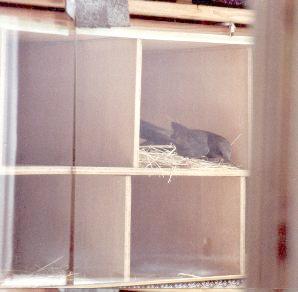
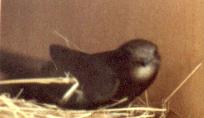 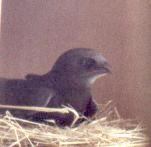
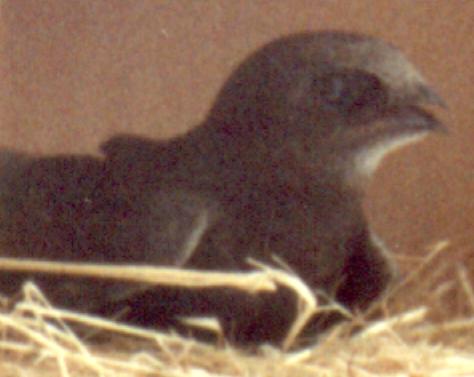
This Swift entered this nest box (which has a glass back wall
for photographic and observation purposes) on 30th June 2001.
As the chin patch appeared very light, and there were light
markings on the leading edge of the lesser wing coverts, my
first impression was that this was a fledgling. I took three
photographs, which are shown above in different sizes.
At the higher angles the throat patch appears less light, but
the wing coverts still look light enough to justify this
supposition.
Given this bird is a juvenile born that year, where did it come
from? Local birds here in Berlin where the nest box is sited
have not yet reached this stage of growth, so the bird has to
come from the South, probably from the Mediterranean area.
While previously it was assumed that young birds on leaving the
nest would immediately head South for their African wintering
areas, research by Tarburton and Kaiser in 2001, revealed that
about a quarter of all fledgling Swifts instead turned North,
and not South.
The miniature radio transmitters used for their research had an
ability to transmit for only a few hours, and as result it was
impossible to ascertain just how far, or for how long, these
birds travelled northwards.
However, it does lend support to the theory that some juvenile
Swifts may head quite far North, taking part in seeking nesting
spaces of older individuals, well before they turn South to
migrate to Africa.
Ulrich Tigges
Sources:
APUSlist-Nos.
0008, 0069,
0084, 0154, 0161, 0178, 0183, 0202, 0249, 0250, 0263, 0265,
0337, 0406, 0440, 0451, 0453, 0490, 0518, 0579, 0590, 0601,
0605, 0634, 0639, 0693, 0719, 0720, 0732, 0733, 0772, 0774,
0783, 0809, 0811, 0811, 0825, 0848, 0853, 0886, 0890, 0891,
0894, 1006, 1047, 1083, 1084, 1088, 1129, 1142, 1148, 1195,
1217, 1221, 1238, 1455, 1457, 1459, 1489, 1489, 1557, 1560,
1579, 1592, 1731, 1838, 1900, 1911, 1924, 2127, 2178, 2179,
2271, 2465, 2468, 2468, 2531, 2619, 2787, Caravan & Motorhome
Sport 04 (1999) and Ludovic 2002
©
APUSlife No. 2866
ISSN 1438-2261
|



